

Starting a business is an exciting yet risky venture. From validating an idea to dealing with competition, entrepreneurs face a host of obstacles, which is why it’s important to understand the main stages of launching a business. Understanding these challenges can significantly increase your chances of success.
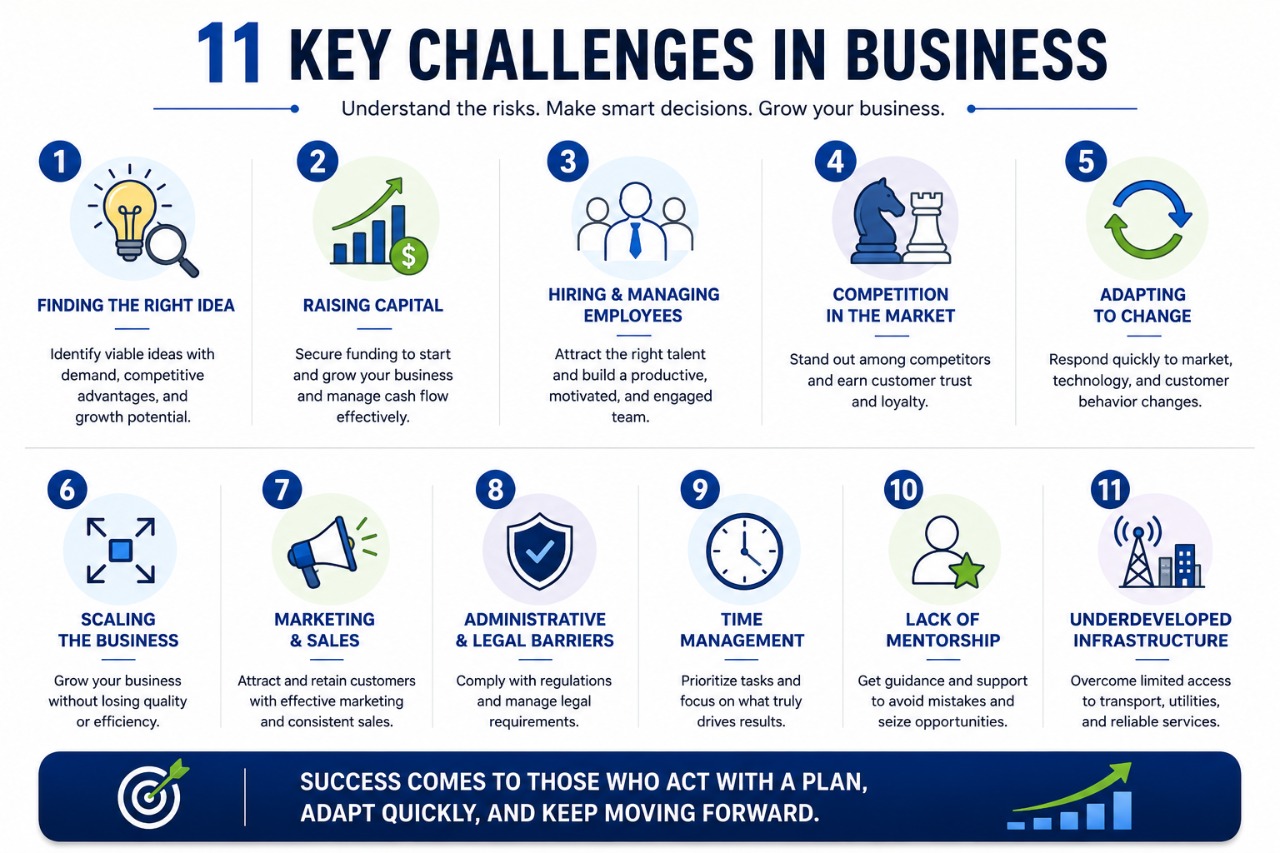
1. Finding the right idea
Choosing a viable business idea isn’t easy. It’s crucial to understand its market demand, competitive advantages, and growth prospects.
How to find the right idea:
- Assess your strengths, skills, and interests.
- Study the market: trends, customer needs, and competitors.
- Conduct a SWOT analysis (Strengths, Weaknesses, Opportunities, and Threats).
- Test the idea with potential customers through surveys or interviews.
2. Securing funding
Many entrepreneurs struggle to find the seed capital to launch and grow their business. This is especially true for new projects and can lead to a shortage of working capital.
How to solve the funding problem:
- Consider different sources: crowdfunding, angel investors, venture capital funds.
- Prepare a detailed business plan with financial projections.
- Build business relationships with investors and experts.
- If necessary, use your own funds and reinvest profits.
3. Hiring and managing employees
Finding qualified employees is a difficult task. Mistakes at this stage can reduce efficiency and increase costs.
How to manage HR effectively:
- Clearly define job requirements.
- Use a multi-stage selection process: interviews, skills tests.
- Provide quality onboarding for new employees.
- Maintain open communication and provide regular feedback.

4. Market competition
Entering a market with strong competitors can be tough; they already have brand recognition and loyal customers.
How to compete effectively:
- Look for untapped or underserved niches.
- Develop a unique selling proposition (USP).
- Build long-term relationships with customers.
5. Adapting to change
The business environment is constantly changing. The inability to react quickly to changes can lead to a loss of customers.
How to stay flexible:
- Keep an eye on trends and new technologies.
- Regularly review your strategy.
- Foster a culture of continuous learning.
- Use analytics to understand customer behavior.
6. Scaling the business
Company growth requires resources and can lead to a decline in the quality of processes.
How to scale without losses:
- Build scalability into the business model from the start.
- Implement automation.
- Regularly adjust your growth strategy.
7. Marketing and sales
A steady stream of customers is key to business growth, but it’s hard to achieve without a systematic approach.
How to improve marketing and sales:
- Study your target audience.
- Use digital channels: social media, SEO, email newsletters.
- Create useful and clear content.
- Analyze results and adjust your strategies.
8. Administrative and legal hurdles
Complying with legal requirements can be complex and time-consuming.
How to reduce risks:
- Consult with lawyers.
- Stay updated on changes in legislation.
- Use systems for accounting and document control.
9. Time management
Entrepreneurs often juggle many tasks, which leads to overload.
How to manage time more effectively:
- Set priorities.
- Break down tasks into stages.
- Use planners and task trackers.
- Delegate tasks when possible.
10. Lack of a mentor
Without experience and support, it’s easy to make mistakes and miss opportunities.
How to find a mentor:
- Participate in professional communities.
- Develop business contacts.
- Attend industry events.
- Clearly articulate your goals when approaching a potential mentor.
11. Underdeveloped infrastructure
Problems with transportation, communication, or power supply can hinder business operations.
How to cope with such limitations:
- Use backup power sources.
- Optimize logistics.
- Choose reliable internet service providers and services.