

E-commerce allows businesses of all sizes to reach a wider audience. Launching an online store is typically cheaper than opening a brick-and-mortar location, making it an especially attractive option for entrepreneurs and those looking for an additional source of income. However, the question of how to start an e-commerce business can seem daunting. In this guide, we’ll walk you through the process of opening your own online store, step by step.
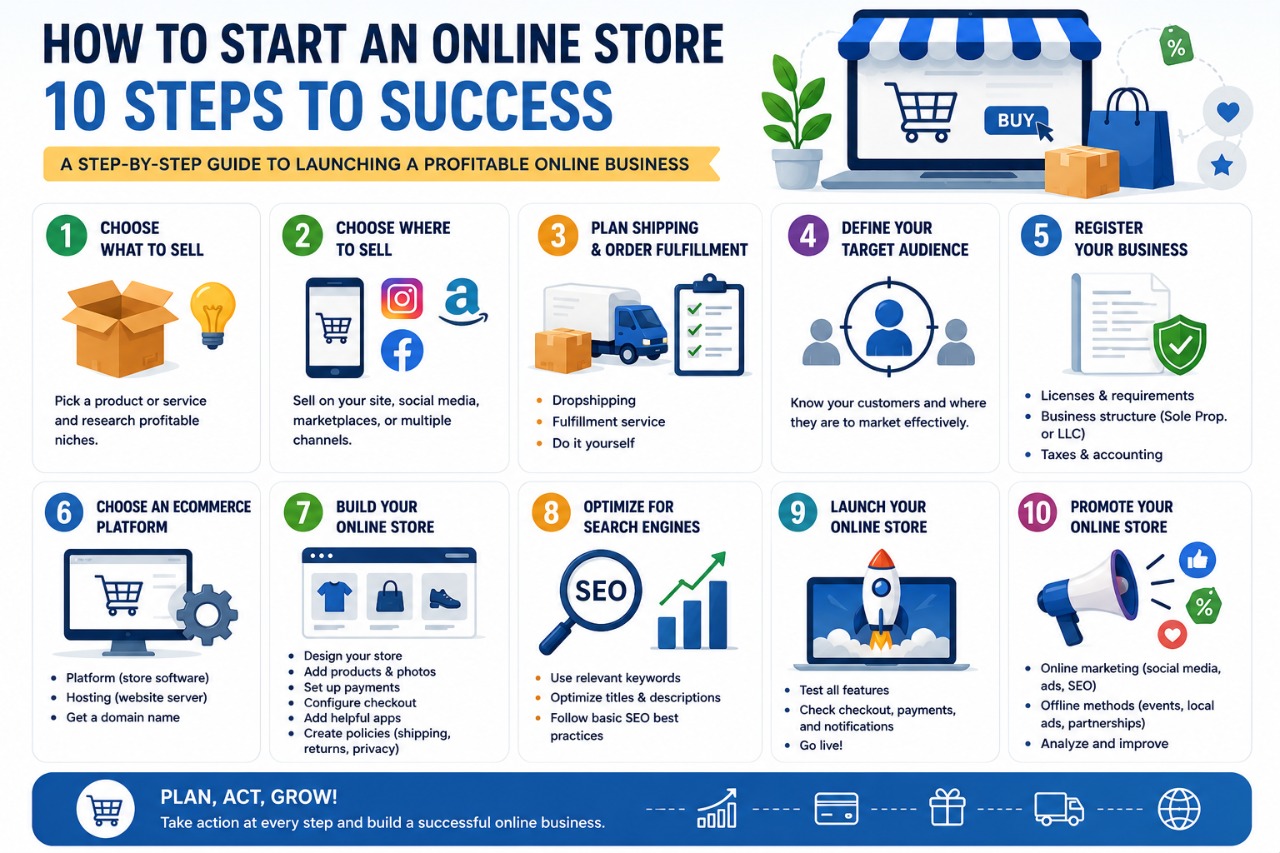
1. Decide what to sell
First, choose a product or service. This choice will influence your platform selection, tax obligations, licensing requirements, and how you manage inventory and shipping.
Main categories:
- Physical products — Goods that need to be shipped to the customer, including dropshipping.
- Subscriptions — Regular delivery of goods or access to digital content.
- Services — Appointments and bookings, such as in the beauty industry or for consultations.
- Digital products — Downloadable items like courses, templates, and illustrations.
Research promising niches and choose something you know well. For example, if you plan to sell homemade dog treats, make sure you have the necessary permits and tested recipes.
2. Choose where to sell
Decide where your sales will happen: on your own website, on social media, on marketplaces, or across multiple platforms at once.
- Social media lets you start quickly but has limited customization options.
- Marketplaces give you access to a ready-made audience but require you to follow strict rules.
- Your own website offers more freedom but requires you to attract customers yourself.
3. Plan for shipping and order fulfillment
For physical goods, it’s crucial to determine how shipping will be handled in advance.
Main options:
- Dropshipping — You don’t purchase products beforehand or handle shipping yourself.
- Fulfillment service — A third-party company stores, packs, and ships your orders.
- Self-fulfillment — You store and ship the orders yourself.
4. Define your target audience
Understand who your customers are. Even for an existing business, the online audience may differ from offline customers. Identify where your customers are and what channels they use — this will help you build an effective marketing strategy.
5. Register your business
Move on to the legal matters.
- Licenses — Requirements vary by type of business and region. Consult a specialist if necessary.
- Business structure — Sole proprietorship or LLC. A sole proprietorship is easier to set up, while an LLC provides greater protection.
- Taxes — It’s important to keep track of income and expenses. Use services that help automate calculations.
6. Choose an e-commerce platform
Decide on the technical foundation for your store.
- Platform — This is the management system for your store.
- Hosting — The server where your site is located.
- Some solutions combine both options.
Register a domain name — this will increase trust in your store. If you’re not ready to launch a full-fledged website, start with marketplaces.
7. Build your online store
Launching requires attention to detail.
- Design — Choose a design that matches your brand.
- Catalog — Prepare high-quality descriptions and photos.
- Payments — Set up reliable payment processing methods.
- Checkout — Create a convenient and clear checkout process.
- Add-ons — Integrate online chat, accounting, and other useful tools.
- Policies — Create shipping, return, and data processing policies.
8. Optimize your site for search engines
Search engine optimization (SEO) helps attract customers from search results. Use keywords and follow basic SEO best practices.
9. Launch your e-commerce business
Before launching, test all functions to ensure they work correctly: checkout, payment, notifications. After that, you can open your store to customers.
10. Promote your online store
After launching, the active work of attracting customers begins.
- Online promotion — social media, advertising, search engine promotion.
- Offline methods — Participating in events, local advertising, partnerships.
A well-thought-out approach at each stage will help you successfully figure out how to start an e-commerce business and build a stable source of income.